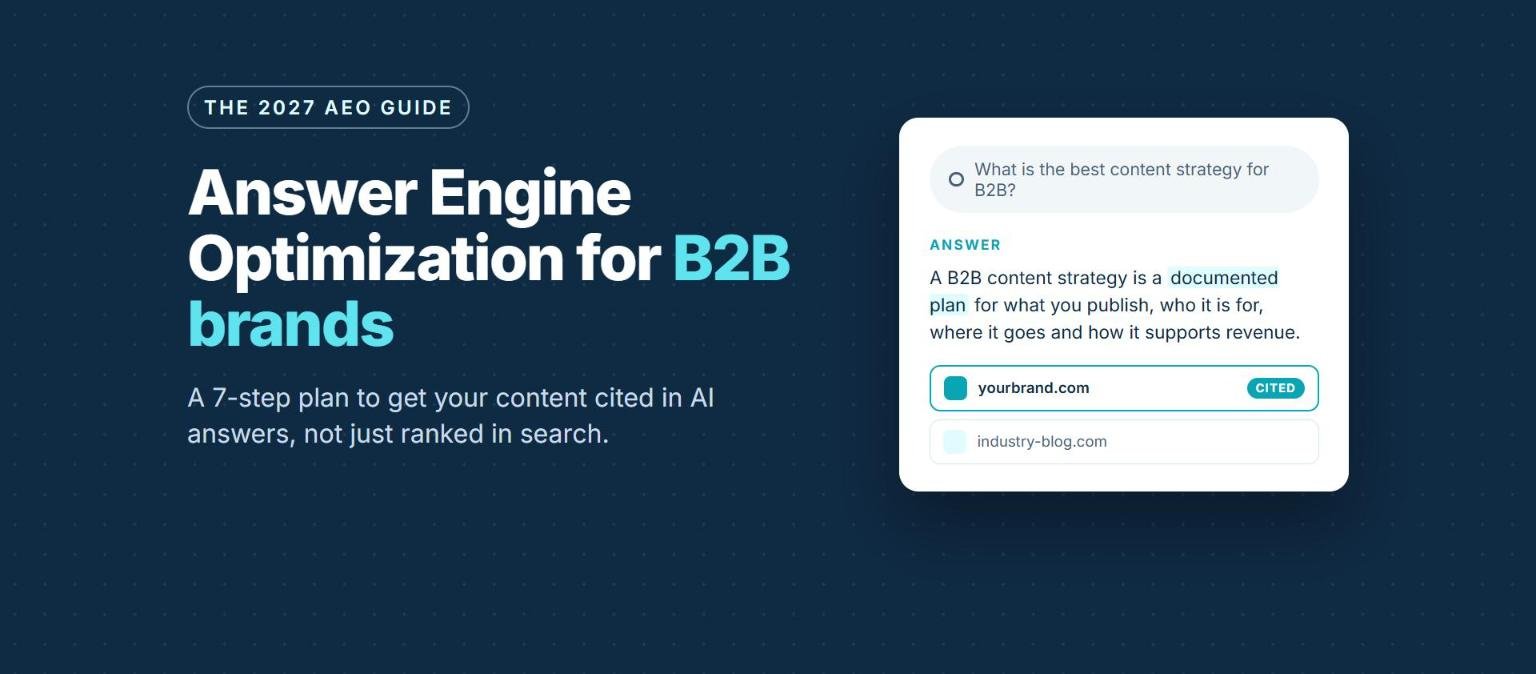
Answer Engine Optimization (AEO): The 2027 Guide for B2B Brands
Key takeaways
- Answer engine optimization (AEO) is the practice of shaping content so Google AI Overviews, AI Mode, ChatGPT, Perplexity and Copilot can find, trust and quote it.
- AEO builds on SEO. It doesn’t replace it. Strong, crawlable, trusted pages are still the foundation.
- Answer engines quote passages, not pages. Put a clear 40 to 60 word answer at the top of every section.
- Most AI Overview citations come from pages outside Google’s top 10, so smaller B2B brands can win citations that big brands hold in rankings.
- Measure citations, brand mentions and AI referral traffic, not only rankings and clicks.
Your next buyer may never see your website’s search listing. They type a question into Google, ChatGPT or Perplexity, read a short answer and move on. If your brand is named in that answer, you are on their shortlist. If it isn’t, you are invisible at the moment that matters most.
This guide explains what AEO is, how answer engines choose what to cite, and a seven-step plan B2B brands can follow in 2027. It ends with a 90-day plan, a checklist you can use today and answers to the questions clients ask me most.
What is answer engine optimization (AEO)?
Answer engine optimization (AEO) is the practice of structuring and writing content so that answer engines can find it, understand it and quote it in their responses. Where SEO aims to rank a page in a list of links, AEO aims to make your brand part of the answer itself.
Answer engines are tools that reply to a question directly instead of showing a list of results. The ones that matter most for B2B buyers today are:
- Google AI Overviews and AI Mode, which summarize answers above or instead of the usual results
- ChatGPT, which now searches the web and cites its sources
- Perplexity, a research-style engine popular with technical and professional buyers
- Microsoft Copilot, built into the tools many B2B teams use every day
- Voice assistants, which read out a single answer
AEO vs SEO vs GEO: what’s the difference?
AEO, SEO and GEO are three views of the same goal: being found when buyers search. SEO earns rankings and clicks. AEO and GEO earn citations inside answers. The work overlaps far more than it differs.
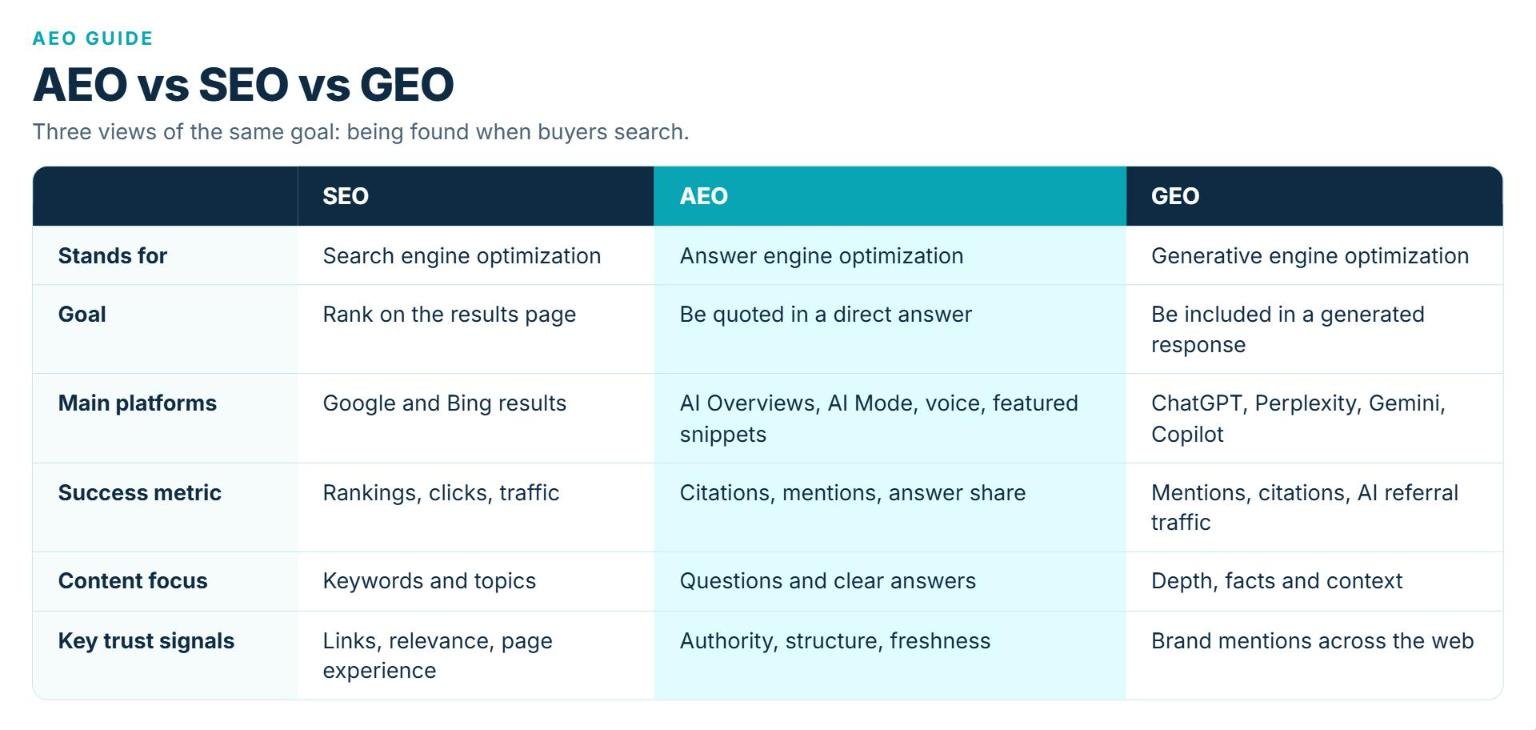
In practice, treat GEO as part of AEO. If you write clear, well-structured, expert content and build mentions beyond your site, you are doing both.
Why AEO matters for B2B brands in 2027
B2B buyers do most of their research before they talk to sales, and more of that research now happens inside answer engines. Three changes make AEO urgent.
1. Fewer clicks reach your site. In a 2025 Pew Research Center study, people who saw an AI summary clicked a traditional result on 8% of visits, compared with 15% when no summary appeared. Ahrefs estimates that AI Overviews reduce the click-through rate of the top-ranked page by 58%. Ranking first no longer guarantees a visit.
2. Buyers build shortlists inside the answer. In a January 2026 HubSpot survey of more than 3,000 CRM decision-makers, 42% used AI search during their evaluation, and those buyers were 36% more likely to purchase. When an answer names three providers or three frameworks, buyers tend to start there.
3. The visitors you do get are worth more. The Opollo 2026 AI Search Benchmark Report, covering 312 B2B tech companies, found that AI-referred visitors converted at 14.2%, compared with 2.8% for Google organic visitors. Someone who clicks through after reading an answer already trusts you.
How answer engines choose what to cite
Answer engines don’t read your page the way a person does. They break it into passages, pick the ones that best answer the question, and check whether the source looks trustworthy and current. Four factors decide whether your passage is chosen.
- Relevance to the exact question. Engines often split one query into several related sub-questions (Google calls this query fan-out) and look for passages that answer each one.
- Position and clarity. CXL’s 2026 analysis of 100 AI Overview citations found that 55% came from the first 30% of the page. Kevin Indig’s study of 18,012 verified ChatGPT citations found a similar pattern, with 44.2% from the first 30%. Answers buried at the bottom are rarely used.
- Trust. Engines favor sources with clear authorship, real expertise and mentions on other trusted sites.
- Freshness. Recent, dated content is preferred for anything that changes, such as tools, pricing or best practices.
Here is the good news for growing B2B brands. An Ahrefs study of 4 million AI Overview URLs found that only 37.1% of cited pages ranked in Google’s organic top 10. Most citations go to pages outside the top 10. Clear, expert answers can win visibility before your rankings catch up.
How to do AEO: a 7-step strategy for B2B brands
Step 1: Build a buyer question map
AEO starts with the questions your buyers actually ask, not the keywords you want to rank for. Collect them from:
- Sales and discovery calls (“How long does onboarding take?”)
- Support tickets and onboarding emails
- Google’s “People also ask” box and related searches
- Reddit, LinkedIn comments and industry communities
- Your own test prompts in ChatGPT and Perplexity
Group the questions by buying stage. Early questions sound like “What is…” and “Why does…”. Middle questions compare options: “X vs Y” and “best way to…”. Late questions are about cost, risk and fit: “How much does… cost” and “Is… worth it for a company our size?” Every stage needs pages that answer it. This is the heart of a good content strategy.
Step 2: Lead with a 40 to 60 word answer
Put a short, complete answer directly under each question heading, then expand. The answer should make sense on its own, because that is how an engine will quote it.
Before: “Content strategy is a topic many businesses struggle with. In today’s fast-moving digital world, it is more important than ever to have a plan. In this article, we will explore…”
After: “A B2B content strategy is a documented plan for what content you publish, who it is for, where it is distributed and how it supports revenue. It covers audience research, topics, formats, a publishing calendar and the metrics you use to judge success.”
The second version answers the question in the first sentence. It can be lifted into an answer without any editing.
Step 3: Structure every page for extraction
Make it easy for an engine to pull out one passage without the rest of the page:
- Write H2 and H3 headings as the questions buyers ask.
- Keep paragraphs to one idea and two or three sentences.
- Use numbered lists for processes and tables for comparisons.
- Define each key term in one sentence before you expand on it.
- Add a key takeaways box at the top of long guides.
This structure also helps busy human readers skim, so you lose nothing.
Step 4: Prove first-hand experience
Generic content that repeats what everyone else says gives an engine no reason to cite you. Add what only your team can say: client examples, your process, results you have measured and opinions you can defend.
Add a clear trust block to every article: a named author with a short bio, the publish and last-updated dates, and links to one or two credible sources. This is what Google calls E-E-A-T: experience, expertise, authoritativeness and trust.
Step 5: Add schema and keep pages easy to crawl
Structured data helps engines read your page correctly. For most B2B sites, start with:
- Article schema with the author and dates
- FAQPage schema for question-and-answer sections
- HowTo schema for step-by-step guides
- Organization schema with your name, logo and social profiles
Then check the technical basics. Make sure your robots.txt doesn’t block the crawlers that answer engines use, keep important text in HTML rather than images, and keep pages fast on mobile. Some sites also publish an llms.txt file that points AI crawlers to their key pages. It is optional and still new, but it is quick to add.
Step 6: Earn mentions beyond your own site
Answer engines form their view of a brand from the whole web, not only your website. Brands that are mentioned often, in the right context, are more likely to be named in answers.
Focus on the places your buyers already read:
- LinkedIn posts and newsletters from your founders and leaders
- Guest articles and expert quotes in industry publications
- Podcasts and webinars in your niche
- Review sites and directories for your category
- Helpful, honest answers in Reddit threads and communities
Describe your company the same way everywhere, so every mention tells the same story.
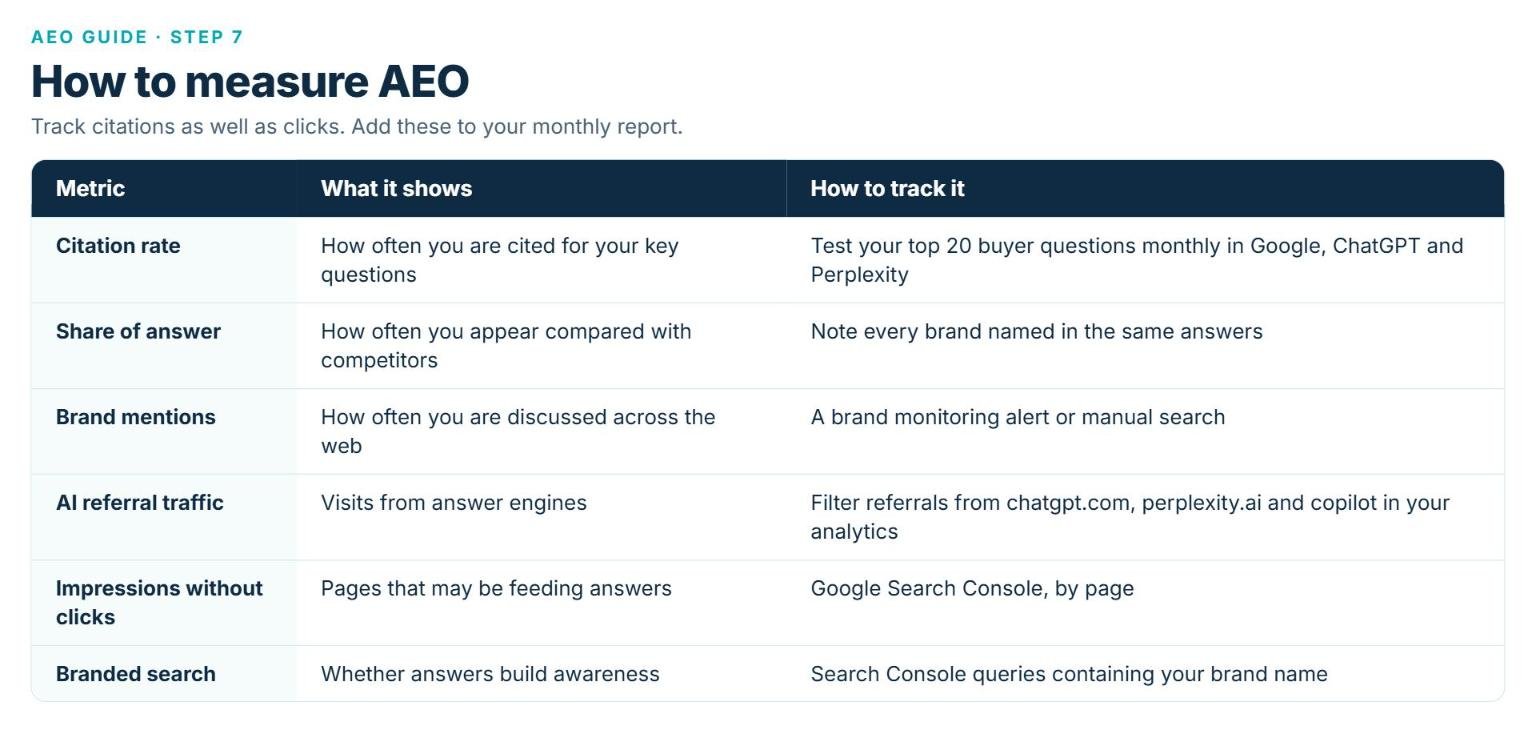
Step 7: Measure citations, not just clicks
Rankings and traffic still matter, but they no longer show the whole picture. Add these AEO measures to your monthly report:
What types of B2B content get cited most
Some formats are much easier for engines to quote than others. Prioritize these:
- Clear definitions of the terms in your industry
- Comparison pages such as “X vs Y” and “in-house vs agency”
- Step-by-step guides with numbered steps
- Pricing and cost explainers that give real ranges
- Original data, such as survey results or benchmarks from your own work
- FAQ pages built from real sales and support questions
- Glossaries that define many related terms in one place
Your 30-60-90 day AEO plan
Days 1 to 30: find your gaps.
- Build your buyer question map (step 1).
- Test your top 20 questions in Google, ChatGPT and Perplexity, and record who is cited.
- Audit your 10 most important pages for answer-first structure, authorship and dates.
Days 31 to 60: fix and publish.
- Rewrite the openings of your top pages with 40 to 60 word answers.
- Add FAQ sections and schema to your key service and blog pages.
- Publish new pages for the most valuable questions nobody answers well.
Days 61 to 90: build authority and measure.
- Pitch guest articles, podcasts and expert quotes in your niche.
- Start a steady posting rhythm on LinkedIn for your leaders.
- Re-test your 20 questions, compare with day 1 and plan the next quarter.
AEO checklist
Use this checklist before you publish or update any page:
- ☐ The page targets a real buyer question
- ☐ A 40 to 60 word answer sits directly under the main heading
- ☐ Headings are written as questions
- ☐ Paragraphs are short, with one idea each
- ☐ Steps are numbered and comparisons are in tables
- ☐ Key terms are defined in one sentence
- ☐ A key takeaways box opens long articles
- ☐ A named author, bio and last-updated date are shown
- ☐ The page includes first-hand examples or data
- ☐ One or two credible sources are linked
- ☐ Article and FAQPage schema are in place
- ☐ robots.txt allows answer engine crawlers
- ☐ The page loads fast and reads well on mobile
- ☐ The page links to related pages on your site
Common AEO mistakes to avoid
- Burying the answer. A long introduction before the point makes your page hard to quote.
- Writing for keywords instead of questions. Repeating a phrase doesn’t make a page more useful.
- Publishing thin, generic content. If your page says nothing new, there is no reason to cite it.
- Hiding authorship. Anonymous pages are harder to trust.
- Letting pages go stale. Review your key pages at least twice a year and update the date when you do.
- Ignoring the rest of the web. A great website with no mentions elsewhere is easy to overlook.
Frequently asked questions about AEO
What does AEO stand for?
AEO stands for answer engine optimization. It is the practice of making content easy for answer engines such as Google AI Overviews, ChatGPT and Perplexity to find, understand and quote.
Is AEO replacing SEO?
No. AEO builds on SEO. Answer engines still rely on pages that are crawlable, well structured and trusted, so strong SEO is the foundation for AEO.
What is the difference between AEO and GEO?
They describe the same shift. GEO (generative engine optimization) usually refers to tools that write long answers, such as ChatGPT. AEO is the broader term for any engine that answers a question directly. The tactics overlap almost entirely.
Does AEO mean writing shorter content?
No. It means putting a short answer first. Long, in-depth pages often get cited more because they answer many related questions, as long as each section opens with a clear answer.
Does every page need an FAQ section?
No. Add FAQs where buyers have real follow-up questions, such as service, pricing and guide pages. Don’t add filler questions just to use FAQ schema.
Do backlinks still matter for AEO?
Yes. Links and mentions from trusted sites are still strong trust signals. In AEO, unlinked brand mentions in the right context also help.
How long does AEO take to work?
Pages that are already indexed can start being cited within weeks of a rewrite. Steady visibility across answer engines usually takes several months of consistent publishing and mention building.
How do I know if AEO is working?
Track your citation rate for a fixed set of buyer questions, AI referral traffic in your analytics, brand mentions and branded search over time.
Can a small B2B brand compete in AEO?
Yes. Answer engines cite the clearest, most useful answer, not only the biggest brand. Since most AI Overview citations come from pages outside the top 10, a focused company with deep expertise can be cited ahead of larger competitors.
Get your content ready for answer engines
AEO rewards brands that write clearly, show real expertise and stay consistent. It doesn’t need tricks. It needs a plan, and content written with purpose.
I help B2B and global brands create content that ranks in search and gets cited in AI answers. With 5+ years in content writing, content strategy and SEO & AEO, I can audit your existing pages, map the questions your buyers ask and write content that earns its place in the answer.
Let’s work together. Tell me about your content goals on the Contact page, and I’ll show you where your brand can start showing up.